

Solar Self-Consumption: What is and why is Key for Energy Saving.
Solar self-consumption is no longer a future trend: it is a present, mature and cost-effective solution for households, companies and communities. Here you will see what it is, what forms exist and why it is key to energy saving.
What is Solar Self-Consumption.
It is the generation of electricity in the same place where it is consumed, usually by photovoltaic panels installed on own decks or land. The energy produced is used directly, reducing the purchase of electricity from the network and thus the electricity bill.
Types of Self-consumption.
- No surplus: the installation has an anti-dumping system that prevents the injection of energy into the network.
- With compensation for surplus: the excess energy is poured into the network and discounted from the electrical bill (simplified net balance sheet).
- Collective: several users share the same facility, ideal for neighbouring communities or industrial polygons.
The benefits of self-consumption.
- I save on the invoice: reduction of electricity expenditure by up to 50-70%.
-Sustainability: lower carbon footprint and direct emission reduction.
-Energy independence: less exposure to price increases.
-Value added: improves the energy rating and revalues the building.
Barriers and Solutions.
The initial cost may be a brake, but there are subsidies, tax deductions (IRPF, IBI) and European funds that facilitate investment. In addition, maintenance is minimal and the useful life of the panels exceeds 25 years.
Practical example of savings.
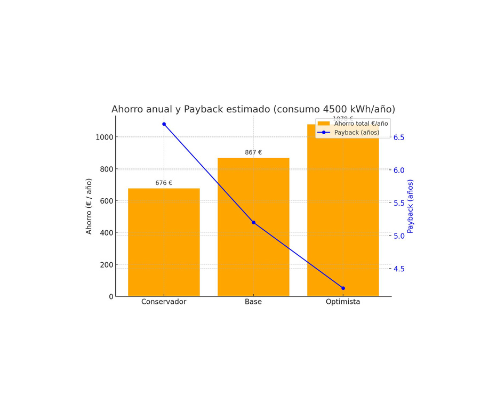
The following graph shows the annual savings (bars) and payback (blue line) for a type home with 4,500 kWh / year of consumption:
Even in the conservative scenario, the return on investment is less than 7 years, and in the optimistic scenario it is reduced to just over 4 years. This leaves more than 15 years of net savings over the service life of the installation (without considering possible additional bonuses).
Conclusion.
Solar self-consumption is an effective tool for controlling electricity spending, protecting itself from price volatility and contributing to a cleaner and more sustainable energy model. It is an investment that combines profitability and environmental responsibility.